Monday, 7 May 2018

Aromatherapy for nausea? Inhaled isopropyl alcohol vs oral ondansetron for nausea in the ED; an RCT


A patient with nausea presents to your ED...

A busy triage nurse to hands a patient an isopropyl alcohol pad and says, “sniff on this.” 

Nausea magically disappears.

Believe it or not, this is not a new concept. The use of aromatherapy to reduce post-operative nausea & vomiting has been studied for decades. But it has only just just recently popped its head (nose?) into the ED.

This was a very well conducted RCT that enrolled 122 young adults with a chief complaint of nausea & vomiting >3 on a numerical rating scale. They excluded patients who had already got IV cannulation and prior antiemetic therapy.

They were randomised to one of three arms:
  • Inhaled isopropyl alcohol alone (with oral placebo)
  • Ondansetron alone (with inhaled saline placebo)
  • Both inhaled isopropyl alcohol and ondansetron

They were told to sniff on the isopropyl alcohol pad as much as they like and could get a new/fresh one about every 10 minutes.

The primary outcome was reduction in nausea as measured on a visual analog scale (VAS) at 30 minutes.

Results?

Both arms using isopropyl alcohol had reductions in nausea by about 30mm. The ondansetron alone arm only had reduction by 9mm. This was statistically significant and the authors made the expected conclusions.

Despite elegant methods, this study did have some important limitations.
  • It is difficult to blind alcohol. (but you can get blind with alcohol… sorry). This could have introduced bias.
  • Persistence and duration of effect is difficult to gage. What about the repeat customer who states, “you’re not going to try to get me to sniff on that alcohol pad again?”
  • These were low risk patients who didn’t need IV’s.
  • Small studies reporting large treatment effect are often disproven

In the discussion, the authors state the mechanism of action remains unclear but could be “related to olfactory distraction.” Perhaps a nausea voodoo dance would have met with the same effect? Who knows…

What should we conclude?

Inhaled isopropyl alcohol might help some low risk patients in the ED with nausea. It is very unlikely to cause harm. But I still like the idea of a voodoo macarena.


Covering:


Sunday, 6 May 2018

Unsuspected Critical Illness Among ED Patients Presenting for Acute Alcohol Intoxication


During my ED training, I was taught the maxim; nobody is ever "just drunk." Of course, this was meant to emphasize caution in recklessly labelling patients as such. Some may have subdurals, infections or other bad illness.

These authors attempted to quantify the proportion of patients who were thought to be just drunk but who ended up requiring critical care resources. In addition, they sought to find clinical features that might be associated with the need for these resources.

Enter Minneapolis, Minnesota. (Evidently, a lot of people resort to drinking here.) Their ED has a “dedicated intoxication unit” where these presumed low risk patients are grouped.

Over five years, they put over 35,000 patients through this area. One patient was readmitted 227 times!

Of these low risk patients, what proportion of them ended up requiring critical care resources?

1%

Abnormal vital signs, hypoglycaemia and parenteral sedation were associated with this outcome. This has face validity i.e. makes sense.

However, this study had substantial limitations.

It was a retrospective review of EHR data which we know to be rather unreliable. It also rested on subjectivity in the definition of their study population and other assumptions.

At best the 1% estimate is a ballpark figure.

But the accuracy doesn’t matter. The overall message has not changed; a small proportion of patients who you suspect to be “just drunk” will really have something bad. Pay attention to vital signs and overall be cautious.

Where have I heard this before?


Covering:

Klein LR, Cole JB, Driver BE, et al. Unsuspected CriticalIllness Among Emergency Department Patients Presenting for Acute AlcoholIntoxication. Ann Emerg Med 2018;71:279-288.
Image result for just drunk


Haloperidol for cannabinoid hyperemesis syndrome; why not…


It seems “Vitamin H” is pretty good for lots of things.

Add it to the list for cannabinoid hyperemesis syndrome (CHS)!

Ok, this “study” if far from high science (forgive the pun). It’s a retrospective chart review reporting a case series of 4 with lots of limitations.

All included patients were thought to have CHS. Perhaps they were diagnosed in the hot shower? They seemed to all have refractory vomiting until they were given haloperidol 5mg IV.

The authors provide some physiologic reasons why this might be efficacious and appropriately temper their conclusion by stating their success “warrants further investigation.”

In summary, this study is arguably a level of evidence just above anecdote. But who cares… did I say I love vitamin H?


Covering:

Witsil JC, Mycyk MB. Haloperidol, A Novel Treatment for Cannabinoid Hyperemesis Syndrome. Am J Therap. 2017;24:e64-7.


Saturday, 5 May 2018

Intralipid emulsion treatment as an antidote in lipophilic drug intoxications- Worst paper of the decade?


This case series from Turkey published in the American Journal of Emergency Medicine is a fabulous example of intoxicated peer review (perhaps they needed the intralipid?)

It is awful from the first sentence.

Intravenous lipid emulsion (ILE) is a lifesaving treatment of lipophilic drug intoxications.

Of course, this is not referenced.  

There is no definitive high-quality evidence demonstrating a reduction in mortality from intralipid. There best evidence is mostly case series. (Although I did find an RCT of 34 cats poisoned by permethrin!)

So, getting past the first sentence is problematic… but I’ll continue.

The authors report a case series of 10 patients admitted to their ED who had allegedly taken overdoses of mostly amitriptyline but also some metoprolol, nifedipine, quetiapine, lamotrigine, sertraline, fluoxetine, alprazolam and of course Bonsai.

Bonsai?

This term is not explained in the manuscript. Gut if you google Bonsai, you get some beautiful images of small trees. If you dig a bit further, you come to discover it is a popular synthetic cannabinoid in Turkey. Who would have known?

Another tangent… back to the paper.

The authors describe each patient in some detail, but don’t really mention if any standard treatment was given. It looks like only one of the patients with TCA overdose ever got sodium bicarbonate except one who (I think) died.

She did not answer cardiopulmonary resuscitation, and she was admitted as exitus.

What should we conclude?

In the end they gave intralipid to 10 patients who may or may not have needed it. They may or may not have derived benefit or harm from this therapy. We’re not sure…

The authors conclude

According to these results, it was found that ILE treatment is a lifesaving agent in lipophilic drug intoxications and can be used in unconscious patients who have cardiac and/or neurologic symptoms, but no history of a specific drug ingestion.

I conclude the authors and the peer reviewers were probably on the bonsai… and I’m not talking small trees.


Covering:

Image result for bonsai

Saturday, 17 February 2018

Predatory journals recruit fake editor

We live in an age of digital scams. Not a day goes past when we aren’t tempted by emails or other messages from nefarious individuals attempting to extract money. Why should academic journals be any different?

A couple of decades ago, it was challenging to manage an academic journal; snail mail, printing costs, office rental, advertisers etc. The digital age and the open-access movement have made it such that anyone with some decent IT skills can create an official looking scientific journal in their attic.

The opening of this study does a great job of summing up the current state of play.

Thousands of academic journals do not aspire to quality. They exist primarily to extract fees from authors. These 'predatory' journals exhibit questionable marketing schemes, follow lax or non-existent peer-review procedures and fail to provide scientific rigour or transparency.

Crucial to the quality of an academic journal is its editors. They should have a strong research background, been involved with peer review and ultimately qualified for the job.

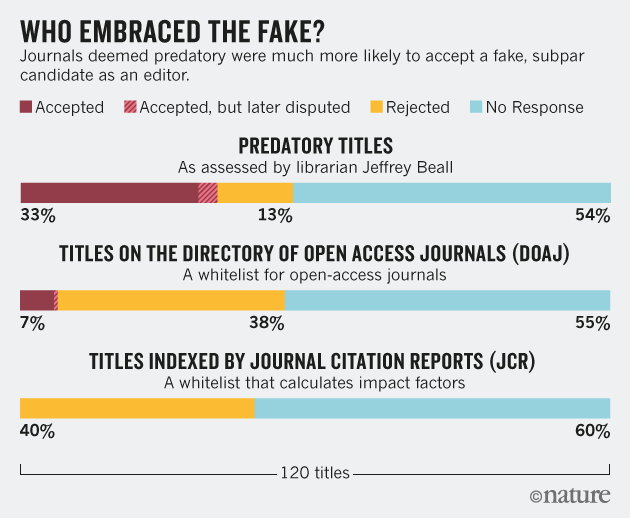
These researchers from Poland concocted a sting to see if a “dismally inadequate” scientist would be invited to be an editor. They created the profile of “Anna O. Szust.” (Oszust is the Polish word for “a fraud.”)

Her CV and application was sent to 360 journals. They were sent to one of three directories; the JCR (journals with an official impact factor), the DOAJ (Director of Open Access Journals), and finally to a group thought to be predatory journals (from Beall’s list).

Results?

None of the JCR journals accepted the application. By comparison, 40 predatory and 8 DOAJ journals appointed her as editor. There were some hilarious and sometimes disturbing responses from the journals. I strongly encourage people to read the original manuscript at this link

What should we take away from this?

  • There are over 10,000 predatory journals on the planet that do not exist for the advancement of scientific knowledge. They are fraudulent and have been created to make money.
  • Be VERY sceptical of papers published in predatory journals. They were likely accepted not on their merit & methodologic rigor but rather their ability to pay a fee.
  • If you are a researcher looking to publish a study, do your homework. Ensure that the journals you engage are known to be reputable.


Covering:


Friday, 16 February 2018

Severe Hyperkalemia: The ECG can risk stratify for short term adverse events?

This may seem rather obvious, but these researchers found little formal evidence to support this notion. As such, they performed this decent but small study.

From their laboratory database, they were able to pull the records of all adult patients over a few years that had a potassium of >6.5 mEq/L. They included patients that had ECG’s done within one hour of the blood test and had no treatment for hyperkalemia.

Two blinded emergency specialists reviewed the ECG’s to record the rate, rhythm, peaked T’s, PR intervals and QRS duration.  

They defined short term adverse events as symptomatic bradycardia, VT, VF, CPR and/or death within 6 hours of the ECG. Relative risk was calculated to determine the association between the ECG changes and adverse events.

Results?

They found 28 short term adverse events in 188 patients with severe hyperkalemia. Most of these adverse events (22) were bradycardia. There were 4 deaths, and 2 episodes each of VT & CPR.

An increased likelihood for adverse events were found for:
  • Bradycardia RR 12.29 
  • QRS prolongation RR 4.47 
  • Junctional rhythm RR 7.46

There was no statistically significant correlation between isolated peaked T’s and short term adverse events. But all adverse events were preceded by ECG abnormalities.

So, it looks like bradycardia is the most powerful predictor?

Not so fast. (Get it… not so fast…)

In this study, bradycardia was both a predictor and outcome variable. Therefore, it comes as no surprise that bradycardia is associated with bradycardia. I’m not sure what to do with this…

The biggest limitation of this study was the small numbers of meaningful adverse events. As such there are wide confidence intervals. No study is really “definitive” and this research would officially be far from this standard.

Nevertheless, what are we to conclude?

An ugly ECG in the setting of severe hyperkalemia is a bad thing. But don't go bananas about isolated peaked T’s (in the short term.)


Ok… this is not earth shattering, but does help fill in the research gap.
Image result for potassium
Covering:

Wednesday, 14 February 2018

Noninvasive Cardiac Testing vs. Clinical Evaluation Alone in Acute Chest Pain: Less is more

These researchers from St. Louis wanted to see if “nothing” was a good diagnostic strategy for the evaluation of low risk acute chest pain.

Ok… not really nothing. But they hypothesised that non-invasive testing (i.e. CTCA, treadmill, stress echo, SPECT) would provide no benefit beyond the typical evaluation using history, physical examination, ECG and troponins.

To try to answer this research question, they got their hands on de-identified data from the Boston led ROMICAT II study. This was a 1000 patient RCT looking at CTCA vs. standard practice in the evaluation of chest pain performed in 9 ED’s in the USA. This robust prospectively collected data was subsequently analysed by these new researchers using a different angle.

They found that 118 (12%) of the 1000 patients did not undergo non-invasive stress testing and they had better outcomes than those who got testing. Specifically, they had shorter lengths of stay, less downstream testing, less radiation exposure and less cost with no change in clinical outcomes.

Apparently there no advantage to performing these non-invasive tests. Less is more.

I love this message.

We never get congratulated for the tests we do not order. Perhaps now is the time for a cultural shift that emphasises the potential harms of these non-specific tests; radiation, cost, time, and most of all overdiagnosis. Let’s clap our hands together for doing nothing!

But unfortunately, my evidence-based bones just can’t completely embrace the conclusions of this study.

This subanalysis was not an RCT. It was up to the physician judgement as to who got non-invasive testing in the usual care arm. It is very likely that the cohort of patients that got nothing were at less risk for bad outcomes. (To be fair, they did try an adjusted analysis, but these are always fraught with problems.)

What are we to think?

It is likely true that over zealous non-invasive testing in low risk patients with chest pain is potentially harmful. A targeted approach for higher risk patients is probably better.

In the end, this study has raised a decent hypothesis for prospectively testing in a proper RCT. If you are a patient with chest pain, perhaps nothing can be a real cool hand.

Image result for cool hand luke

Covering: