Monday, 13 July 2020

Electrical vs pharmacological cardioversion for ED patients with acute atrial fibrillation

This was in fact two RCT’s.

The primary one was comparing conversion to sinus rhythm between a drug-before-shock strategy vs. shock only for cardioversion of acute (<48 hours) atrial fibrillation. The second was a nested RCT comparing anterioposterior vs. anterolateral pad placement.

They enrolled about 400 patients. Half were randomised to procainamide infusion before an attempt at DC cardioversion. The other half got matching placebo followed by DC cardioversion.

Both strategies were highly effective in conversion to sinus rhythm at 96% with drug/shock vs. 92% for shock only (95%CI 0-9; p=0.07). Pad placement didn’t matter.

Of note, the procainamide worked for half of the patients and they were able avoid electricity and procedural sedation.

But not emphasized in the paper was the success of doing nothing. Many patients self-reverted during their ED stay and even with placebo infusion. Perhaps we should adopt a wait-and-see approach as suggested by the Dutch and Doyle?

There are a few things to note.

They reported no adverse events at follow up. (But there was one case of “cardiac arrest” when they forgot to hit the sync button… woops!) As per prior similar studies, it looks safe.

The cohort was a bit younger (mean age 60) and most had AF for less than 12 hours. Therefore, care should be taken when extrapolating this study to older patients with longer duration of AF.

11% of patients returned to the ED with recurrent AF within 14 days. This very likely underrepresents the amount of recurrence. Which begs the question of why bother…

There was a trend towards efficacy with the drug shock group with NNT of 25 for more successful overall conversion. This makes physiological sense.

Of course, the biggest issue is procainamide is not officially available in Australia and in some other countries. The authors suggest other antiarrhythmics might be useful.

Overall, I think this is compelling evidence to a consider a drug/shock strategy. But I still think doing nothing might be even better. Time for shared decision making.


Covering:

Steill I, Sivlotti M, Taljaard M, et al. Electrical vs pharmacological cardioversion for emergency department patients with acute atrial fibrillation (RAFF2): a partial factorial RCT. Lancet 2020;395:339-49. [link to article]

SGEM#260: Quit Playing Game with My Heart – Early or Delayed ...

Multicenter Emergency Department Validation of the Canadian Syncope Risk Sore

Syncope Rules?

We all love syncope with its ubiquity and complexity. Most causes are benign but the needle in the haystack may be fatal. Wouldn’t it be nice to have a good clinical decision instrument to help us out?

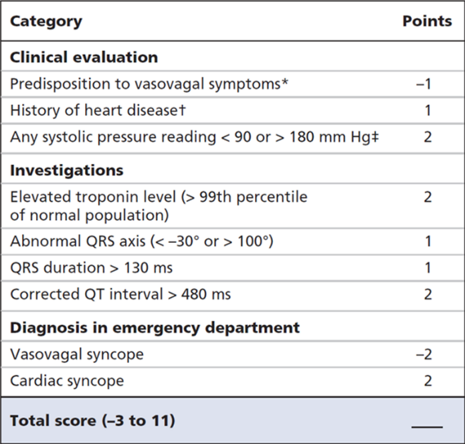
These researchers sought to validate the Canadian Syncope Risk Score (see below) among 3819 patients that presented across 9 ED’s in Canada.

The risk score is mostly a quantification of what we evaluate already. History, ECG, ED diagnosis and troponin (if performed). Score ranges from -3 to 11 and patients are put into one of five categories; very low, low, medium, high or very high risk.

The primary outcome was “30-day serious outcomes” as determined during medical record review, telephone follow up, return visits, and coroners’ database.

Results?

The proportion of patients with serious outcomes increased from 0.3% in the very low risk group to 51% in the very high risk group.

This seems ok but I’m not so sure this “rule” will gain traction.

First, it’s too complicated to commit to memory. We would need to refer to MDCalc which will decrease its utility.

Second, it hasn’t formally been compared to what we already do… which is gestalt. (However, some may argue that it is already heavily reliant on gestalt.) It is possible that following the rule could make things worse. 

Third, we know rules tend to perform less well in complex disease processes. This is why doctors have not been replaced by robots… yet.

How might I use the rule?

Probably how we use most rules; something we can write in the medical record to support a decision we have already made. This might sound cynical, but gestalt is probably the best rule.


Covering:

Thiruganasambandamoorthy V, Sivilotti M, Le Sage N, et al. Multicenter Emergency Department Validation of the Canadian Syncope Risk Score. JAMA Intern Med. 2020;180:737-44. [link to article]

You passed out, Eh?- The Canadian Syncope Risk Score and its use ...


Saturday, 11 July 2020

Apixaban for the Treatment of DVT/PE Associated with Cancer


Most DVT’s and PE’s in patients with cancer are treated with low molecular weight heparin. As if the malignancy was not enough, now they will get painful daily injections often for the rest of their life.

Seems cruel… why not just use a DOAC?

In turns out, there was no good evidence that they could be used in this population and there was some concern about increased bleeding.

Sounds like a good reason for a clinical trial?

These authors performed a randomized open-label noninferiority trial comparing apixaban to daltiparin in over 1000 patients in 119 centres in Europe, Israel and the USA.

They excluded patients with any CNS malignancy, leukemia, basal and squamous cell skin cancers, or if they were high risk of bleeding.

The primary outcome was recurrent DVT/PE during the trial period.

Results?

Recurrent DVT/PE occurred in 5.6% of the apixaban group and 7.9% of the daltiparin group. This met their non-inferiority margin but was not quite enough to claim superiority (p=0.09). Major bleeding was the same in both groups.

All good?!?

Maybe…

There was a trend towards more “clinically relevant” non-major bleeding with apixaban at 9% compared to 6% . This should lead to some caution as they already excluded those with high risk of bleeding.

Although the authors claim this was an “investigator-initiated” trial, it was funded by a “Bristol-Myers Sqibb-Pfizer Alliance.” In addition, there is an impressive list of author conflicts of interest- lecture & consulting fees, grant money, travel expenses, advisory board fees, etc. etc.

Either way, this trial published in the NEJM will be considered “high quality evidence” and will change the guidelines. Hopefully it's right.


Covering:

Agnelli G, Becattini C, Meyer G, et al. Apixaban for the Treatment of Venous ThromboemolismAssociated with Cancer. N Engl J Med 2020;382:1599-607. [Link to article]


Thursday, 21 May 2020

Early self-proning in awake, non-intubated patients in the ED: A single ED’s Experience during the COVID-19 pandemic


This pilot study was carried out at the crazy Lincoln Medical Center, New York City. Located in the Bronx, it is the third busiest ED in the United States. In the grips of a pandemic, it is the perfect place to study potential treatments of COVID-19.

Awake proning has been shown to be beneficial in patients with ARDS and anecdotal reports have suggested it may be helpful for patients with coronavirus.

This pilot study enrolled a convenience sample of 50 patients who presented to their ED with hypoxia without resolution despite supplemental oxygen and who were capable of self-proning. They excluded patients who were NFR, getting NIV or intubated in the prehospital setting. All were eventually confirmed as COVID positive.

They termed these patients the “happy hypoxemics” as they generally looked quite well without respiratory distress despite having low oxygen saturation.

Results?

The median SpO2 at triage was 80% and this improved to 84% with supplemental oxygen. After 5 minutes of proning the saturation increased to 94%!

18 of the 50 patients eventually required intubation; 13 of those (24%) within the first 24 hours.

This pilot study has lots of limitations; no control group, no idea if proning resulted in meaningful patient-oriented outcomes. Nevertheless, it has adequately raised the hypothesis for a clinical trial.  A search of www.clinicaltrials.gov shows there are now several in progress.

Could there be harm from self-proning? It is possible. But these authors recommend proning until we get better quality evidence to inform practice. They have typical protocols whereby patients are asked to rotate about every 30 to 120 minutes.

Proning support cushions are already being sold in the USA. You can get one for US$164! I would not be surprised if a device manufacturer comes out with a human rotisserie device. No joke… watch this space!


Covering:

Caputo ND, Strayer R, Levitan R. Early Self-Proning in Awake, Non-intubated Patients in the Emergency Department: A Single ED’s Experience during the COVID-19 Pandemic. Acad Emerg Med. 2020;27(5):375-378 [link to full text article]


Intranasal ketamine for analgesia prior to digital nerve block- A double blind RCT!!??


Wow…

This was reportedly a double blind RCT of intranasal ketamine 50mg vs. saline placebo prior to performance of digital nerve blocks at a single centre in Iran. All the blocks were done by one doctor (listed as the third out of seven authors).

The primary outcome was reduction of pain during the block as measured on a visual analogue scale (VAS).

Results?

Exactly 100 patients were enrolled. Block pain was less in the group that got IN ketamine 28mm vs. 47mm (P less than 0.001) on the VAS. Side effects were reported to be “trivial.” This pain reduction persisted at the 45-minute mark at 21mm vs 43mm (P less than 0.001).

The authors conclude, “… IN Ketamine can be effective in reducing pain in patients with acute pain, without adding significant side effects.”

I doubt that many of us would consider giving ketamine prior to a digital nerve block. It does seem rather excessive and puts the patient at risk of side effects. (Reminds me of propofol for migraine) Perhaps we might consider inhaled nitrous oxide or intranasal fentanyl?

Unfortunately, there are a few problems and red flags with this study.

  • The final study methods differ quite substantially from those listed in the trial registry found here.  The primary outcome was different, no power calculation, measuring tool different, etc.
  • Intranasal ketamine burns and tastes bad. This could have unmasked blinding resulting in measurement bias.
  • Data was collected in 2014. Why did it take 5 years to get published? I’m guessing it was rejected for publication from numerous journals.
  • In the manuscript, there are numerous grammatical and spelling errors. What does a sloppy manuscript say about the conduct of the study?
  • Why did patients continue to report substantial pain after the nerve block? Most of these blocks should have been successful at complete analgesia.
  • Side effects were likely under-reported


Regardless of this study's conduct or limitations, I’m not a big fan of intranasal ketamine. Not great bang-for-buck and an undesirable side effect profile. In addition, we have experience with other drugs that are more efficacious.


Covering

Nejati A, Jalili M, Abbasi S, et al. Intranasal ketamine reduces pain of digital nerve block; a double blind randomized clinical trial. Am J Emer Med. 2019;27:1622-1626.


Wednesday, 20 May 2020

Targeted Temperature Management for Cardiac Arrest with Nonshockable Rhythm


The literature regarding cooling of comatose survivors of cardiac arrest is mixed. But even more controversial is the role of therapeutic hypothermia in the group of patients with non-shockable rhythm.

Enter the HYPERION trial published in the high impact New England Journal of Medicine.

This mammoth effort was an open-label pragmatic RCT comparing hypothermia (33 degrees) vs normothermia (37 degrees) in comatose survivors of cardiac arrest with non-shockable rhythms (PEA or asystole).

As if PEA and asystole were not bad enough, they excluded the sicker patients who would have highly likely died anyway- regardless of cooling or no cooling. These were patients who had no CPR for >10 minutes, CPR for more than 60 minutes, those with high vasopressor requirements etc.

The primary outcome was a good one; survival with a favorable day-90 neurologic outcome. This was defined as independent & able to perform ADL’s (CPC score 1-2). Unfortunately, it was possibly poorly determined by a single blinded psychologist by phone interview.

Results?

Over 4 years, 581 patients were included from 25 French ICU’s. On day 90, 10.2% of the hypothermia group vs. 5.7% of the normothermia had a good outcome (difference 4.5% 95%CI 0.1 to 8.9; P=0.04 and a NNT of 22.) Overall mortality did not differ between the groups at 80%.

Cooling wins!?

Despite the results, I am a bit less enthusiastic about this one.

The literature is still conflicting, and this is far from overwhelming data.

The primary result has a fragility index of 1. If only one of the patients that did well in the hypothermia group were reclassified as unfavorable at 90 days, the results would not have been statistically significant… we would be talking about a negative trial.

There are other issues with the measurement of the primary outcome, external validity and a few other things.

In the end, it is probably fine if your ICU wants to cool these patients. But please make sure it does not distract & get in the way of providing adequate resuscitation and supportive care. Stay cool (or not) and do the right things first.


Covering:

Lascarrou JB, Merdji H, Le Gouge, A, et al. Targeted Temperature Management for Cardiac Arrest with Non-Shockable Rhythm. New Engl J Med; 2019: 381:2327-2337. [link to article]


Friday, 24 April 2020

Compassionate use of Remdesivir for Patients with Severe Covid-19


It is a sign of the times when an article of such low-quality evidence is published in the New England Journal of Medicine. We are obviously desperate to get some information regarding therapy for Covid-19.

Compassionate use, or properly termed “expanded use,” is when patients can request a not yet FDA approved drug outside of a clinical trial.

This industry funded and written study reports on 53 patients with severe Covid-19 that got expanded use remdesivir in the USA, Europe and Japan.

Short answer… they got it and they got better.

Of course, we have no idea if remdesivir did anything. This was not a trial. There was no control group, no randomization, no blinding, nothing, zip, nada.

But fear not. Gilead Sciences, the manufacturer of remdesivir, is currently conducting a large phase 3 randomized clinical trial. They plan to enroll 6000 patients at 179 sites and have it finished by a “holy shit fast” May 2020!

Fortunately, most of their recruiting sites are based in the USA where there is plenty of patients to study. (Thanks Donald). Studies out of China have now been suspended or terminated due to low patient numbers.

A search of www.clinicaltrails.gov indicates the primary outcome of the phase 3 trial is an odds ratio of improvement on a 7-point ordinal scale. This type of analysis has incredible statistical efficiency. Along with 6000 patients, this study will have the power to demonstrate miniscule differences in patient outcomes.

Do you know what else Gilead Sciences developed?

Tamiflu.

Gilead licensed the drug to Roche in 1996 on return for royalties. Despite hardly any evidence of efficacy, it was a blockbuster that saw the world stockpile billions worth during H1N1.

Now if there was just some other global scare that might sell remdesivir? Hmmmm….

Ok, I am being paranoid. But I do think we need to be careful when this study is soon published and not let emotions & politics trump science. (Pun intended.)

Nevertheless, I genuinely hope this drug works. We have antivirals that have cured hepatitis C. We’ve put the brakes on HIV. In theory, remdesivir looks quite promising. It is an RNA polymerase inhibitor specifically designed to treat coronaviruses. Perhaps there is some hope.

So, watch this space.

But be skeptical.


Covering

Grein J, Ohmagari N, Shin D, et al. Compassionate use of Remdesivir for Patients with Severe Covid-19. N Engl J Med 2020 [E pub ahead of print] [link to full text]